B.Sc. in Environment and Ecotourism
Program Profile
Include a brief description of the main focus of the program. The Environmental and Ecotourism Management Department is a pioneering academic program established to meet the growing demand for sustainable natural resource management, responsible tourism development, and the protection of the Kurdistan Region’srich biodiversity and cultural heritage. The department is committed to equipping students with the scientific knowledge, technical skills, and ethical values necessary to address the region’s environmental challenges while promoting eco-friendly, economically viable tourism opportunities that empower local communities and safeguard the natural environment. At the heart of the program is the integration of environmental management, ecotourism, and agritourism development. Students will engage in comprehensive studies of natural ecosystems, wildlife, and protected areas, learning how to conduct ecological surveys, biodiversity assessments, and environmental impact evaluations using modern field techniques and Geographic Information Systems (GIS) tools. The program places a strong emphasis on ecological restoration practices such as reforestation, wetland rehabilitation, and wildlife habitat conservation — essential for maintaining the region’s ecological balance and supporting sustainable tourism initiatives. In addition to its environmental management focus, the department prioritizes the documentation, preservation, and interpretation of cultural heritage and indigenous knowledge, especially related to ethnobotany and traditional medicinal plant use. Students will study how to integrate this knowledge into community-based ecotourism programs, creating meaningful visitor experiences that highlight the region’s ancestral traditions, natural landscapes, and rural lifestyles. By doing so, graduates will play a crucial role in bridging the gap between ancient wisdom and contemporary scientific approaches to conservation and health.The department also actively promotes agrotourism as an important component of sustainable rural development. Students will learn about organic farming systems, traditional food production, and farm-based tourism enterprises, gaining practical skills in managing agricultural landscapes in ways that support both environmental sustainability and rural livelihoods. This aspect of the program encourages students to design tourism experiences that connect visitors with local farmers, natural food products, and authentic village life — creating opportunities for income generation, cultural exchange, and environmental education. Further, students will explore critical environmental topics such as water resource management, aquatic ecosystem conservation, waste management in tourism areas, and pollution control. They will also study the growing fields of eco-therapy, nature-based wellness tourism, and outdoor recreation planning, learning how to develop health-focused tourism programs that benefit both local communities and visitors. Through hands-on fieldwork, applied research projects, internships, and community outreach initiatives, students will develop leadership, teamwork, communication, and project management skills essential for professional success. Graduates of this program will be fully prepared to work with government institutions, environmental NGOs, private tourism companies, and local communities, contributing to the sustainable development of the Kurdistan Region.
Occupational profiles of graduates
Give a brief description of the types of jobs for which the programed prepares students and/or that graduates generally fulfill. Graduates of the Environmental and Ecotourism Management program are prepared for diverse careers across environmental conservation, sustainable agriculture, ecotourism, and community development. They can serve as ecological surveyors, biodiversity specialists, environmental consultants, and park rangers, working to protect ecosystems, wildlife habitats, and natural resources. In agriculture, they may become organic farming advisors, agritourism managers, or specialists in medicinal plant cultivation, supporting rural livelihoods and eco- friendly food production. The ecotourism sector offers opportunities as planners, visitor managers, and cultural heritage interpreters, enabling graduates to design responsible tourism experiences that connect visitors with nature and local traditions. Beyond these fields, graduates are well-suited for roles in NGOs, private tourism enterprises, and consultancy, where they contribute to awareness campaigns, rural development, and sustainable tourism strategies. Many are also equipped to establish their own ventures, such as eco-lodges, herbal product industries, or farm tourism businesses, fostering environmental stewardship while promoting regional identity and economic sustainability.
Qualification awarded
Bachelor of Science in Environment and Ecotourism
Length of programme
4 years
Number of credits
240 ECTS credits
Mode of Study
Full time
Read more about the programme
Get detailed information about the programme requirements, courses, credits, and educational objectives as a PDF file.
Program Educational Objectives (PEOs)
1.Environmental Knowledge & Research
- Build a strong foundation in ecosystems, biodiversity, protected areas, and environmental issues of Kurdistan and Iraq.
- Strengthen research skills in biodiversity monitoring, ecosystem services, and protected area management.
- 2. Ecotourism Planning & Sustainable Development
- Equip graduates to design and manage ecotourism projects that conserve biodiversity, promote local culture, and support rural livelihoods.
- Apply Environmental Impact Assessment (EIA) tools to mitigate tourism and infrastructure impacts.
3.Community Engagement & Traditional Knowledge
- Promote awareness campaigns, conservation initiatives, and environmental education programs with schools, communities, and tourists.
- Integrate traditional ecological knowledge (TEK), including medicinal plants and cultural landscapes, into modern strategies.
4.Leadership, Ethics & Policy Development
- Train graduates in leadership, teamwork, and intercultural communication for collaboration with diverse stakeholders.
- Foster ethical responsibility in conservation and develop sustainable tourism policies with government, NGOs, and the private sector.
Program Learning Outcomes
After successfully completing this program students should have:
- Design and Implement Ecological Restoration and Protected Area Projects: Plan and manage habitat recovery, reforestation, native species reintroduction, and conservation zoning using field techniques and GIS tools.
- Develop Sustainable Eco-Landscapes and Tourism Infrastructure: Integrate ecological principles into the design of environmentally friendly tourism sites, trails, and landscape management that respect natural and cultural values.
- Promote Biodiversity-Based Enterprises and Sustainable Agriculture: Engage in apiculture, organic farming, and medicinal plant cultivation while exploring eco- education, branding, and green marketing strategies.
- Document and Preserve Cultural and Ethnobotanical Heritage: Record traditional knowledge related to medicinal plants, cuisine, and rural customs, integrating them into authentic community-based tourism experiences.
- Prepare Environmentally Responsible Tourism Development Plans: Draft ecotourism strategies with environmental impact assessments that balance ecological integrity with tourism growth.
- Enhance Water, Waste, and Health Management in Tourism Areas: Design sustainable systems for water use, sanitation, pollution awareness, and health promotion through natural practices.
- Encourage Community Participation and Stewardship: Involve local communities in ecotourism planning, training, and benefit-sharing to ensure ownership and long-term sustainability.
- Conduct Biodiversity and Environmental Assessments: Perform ecological surveys, habitat mapping, and species monitoring using field methods and spatial analysis tools to supportconservation-based tourism.
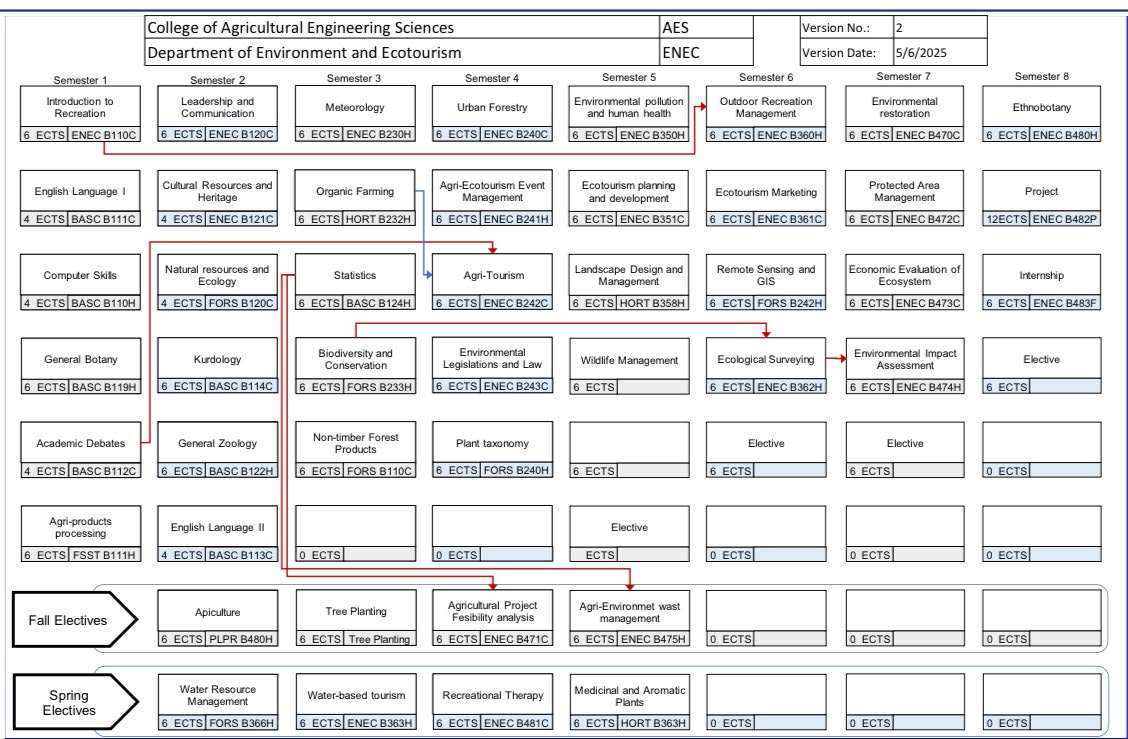
Programme structure diagram with credits
Yearly Timeline
Sept. 1, 2026
⚠️ First year students start around mid-October
⚠️ First year students start exams around 20 of January
July 1, 2027
Check out the full academic calendar on UoD's webstie.
Programme Coordinator

Assistant Professor in Medicinal Plants
Environment and Ecotourism
College of Agricultural Engineering Sciences
University of Duhok
Apply to the Programme
Public undergraduate admissions in the KRG region are managed centrally by the Ministry of Higher Education through the online ZankoLine portal (regayzanko.com). After Grade 12 Baccalaureate results are released, high schools provide students with unique login credentials to rank their preferred universities and B.Sc. majors during a 10–14 day registration window. Final placement is automatically determined by the student's Grade 12 average, subject choices, and department capacity.